
Open Science needs Open Data to maximize the transparency, reproducibility and reuse of scientific efforts. An example of a high demand for data is the research about climate change, for example about the role of deforestation in it.
Deforestation and its related phenomena such as market prices of agricultural products form together a complex system. To analyze and model this kind of a complex environmental and societal system there is an urgent need to share and publish research data. This is needed because it enables other researchers to interconnect their data to the published ones. This allows for the combination of all of the resulting linked data to be used as a source for the analysis of the whole complex system, and not just a subset of all the interesting operations and processes of the system.
Linked Brazilian Amazon Rainforest Data is such a dataset that is openly available for anyone to use for non-commercial research. The data was produced as a joint effort by the Institute for Geoinformatics, University of Muenster, Germany and the National Institute for Space Research (INPE) in Brazil.
The data can be accessed in a Linked Data fashion via a SPARQL-endpoint, and via dereferenciable URIs. The data consists of 8250 cells—each of size of 25 km * 25 km—capturing the observations of deforestation in the Brazilian Amazon Rainforest and a number of related and relevant variables. This spatiotemporal deforestation data was created using a number of aggregation methods from different sources. The data covers the whole Brazilian Amazon Rainforest.
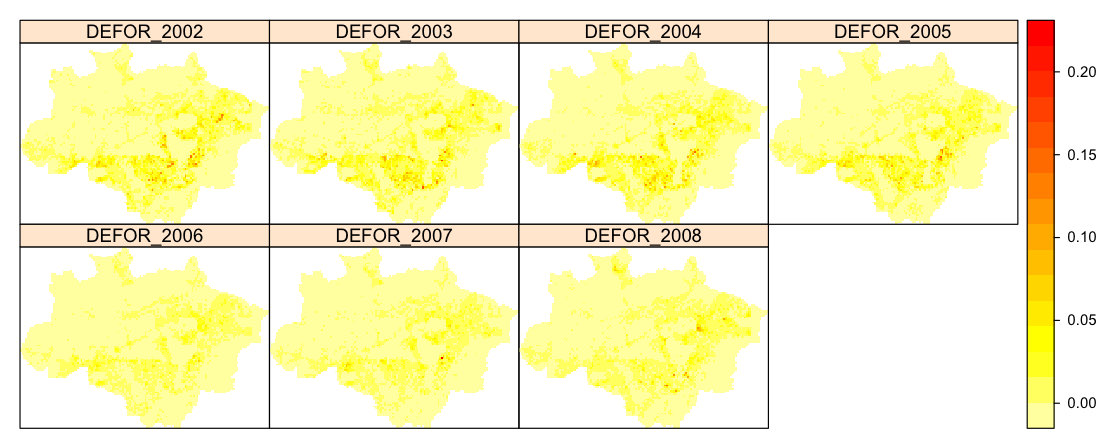
Easiest way for time-being of learning how to utilize the data is to go through a tutorial having examples of accessing, analyzing and visualizing this spatiotemporal data using SPARQL query language in R statistical computing environment. Below is an example visualization that one can create by following the instructions of that tutorial.
Credits about the data:
- Project leader and publication of the data using Linked Open Data technologies:
Dr. Tomi Kauppinen - The data originates from a variety of Brazilian authorities (INPE, MMA, FNP and IBGE).
- The following publication describes the 2.0 version of the data (considerably enriched):
- Tomi Kauppinen, Giovana Mira de Espindola, Jim Jones, Alber Sanchez, Benedikt Graeler and Thomas Bartoschek. Linked Brazilian Amazon Rainforest Data.Semantic Web Journal, Volume 5, Number 2, 2014, IOS Press. [BibTeX]
- About aggregation of the data to 25km x 25km grid cells, see the following publication:
- Espindola, G. M. (2012). Spatiotemporal trends of land use change in the Brazilian Amazon. PhD Thesis. National Institute for Space Research (INPE), São José dos Campos.
Script for R to analyze the data:
- Original version by Giovana M. de Espindola. [1]
- Linked Data enabled version by Dr. Tomi Kauppinen [2] and Benedikt Gräler [3] which makes use of the SPARQL package for R.
Examples about variables used to describe the data:
An example cell and its description as Linked Data:
There is a description of the dataset available that make use of the VoID (Vocabulary of Interlinked Datasets) vocabulary:
- amazon:datasetv2.0
- also available as a separate TTL file
For citing the project, please use the following publications:
- Tomi Kauppinen, Giovana Mira de Espindola, Jim Jones, Alber Sanchez, Benedikt Graeler and Thomas Bartoschek. Linked Brazilian Amazon Rainforest Data.Semantic Web Journal, Volume 5, Number 2, 2014, IOS Press. [BibTeX]
- Tomi Kauppinen, Giovana Mira de Espindola and Benedikt Graeler. Sharing and Analyzing Remote Sensing Observation Data for Linked Science. In poster proceedings of the 9th Extended Semantic Web Conference 2012 (ESWC2012), Heraklion, Crete, Greece, May, 2012. [BibTeX]
[1] Earth System Science Center, National Institute for Space Research (INPE),
Av dos Astronautas 1758, 12227-010 Sao Jose dos Campos Brazil
[2] http://kauppinen.net/tomi
Institute for Geoinformatics, University of Muenster,
Weseler Strasse 253, 48151 Muenster, Germany
[3] Institute for Geoinformatics, University of Muenster,
Weseler Strasse 253, 48151 Muenster, Germany
For a demonstration of using the data, check for instance
- Suvodeep Mazumdar and Tomi Kauppinen. Visualizing and Animating Large-scale Spatiotemporal Data with ELBAR Explorer. In Proceedings of the ISWC 2014 Posters & Demonstrations Track, a track within the 13th International Semantic Web Conference (ISWC 2014), Riva del Garda, Trentino, Italy, October, 2014